Background and problem statement
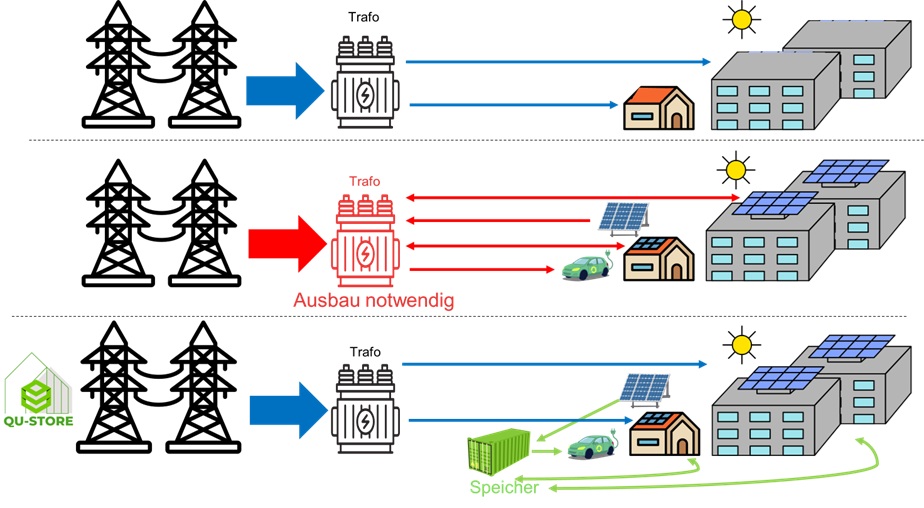
Austria’s energy transition is increasingly pushing the existing electricity distribution networks to their limits. Historically, these networks were designed for centralised generation and predominantly unidirectional load flows. Today, however, photovoltaics, decentralised generation, electric mobility and electric heating dominate the landscape. Particularly at the outer reaches of the grid, this leads to feed-in and load peaks that the originally dimensioned cables and substations can only accommodate to a limited extent. In many regions, grid expansion is thus shifting from being an enabler to a bottleneck for the energy transition.
The traditional response to these bottlenecks involves replacing substations and upgrading power lines. These measures are capital-intensive, complex to plan and, given the long lead times for transformers, can hardly be implemented in a timely manner. Investment requirements are rising significantly for grid operators and the public sector. In the long term, there is a risk of higher grid charges and thus additional burdens for households and businesses. For SMEs, this means uncertain grid connection conditions, delays in business expansion and a higher risk when investing in electric mobility or their own PV systems.
The situation is particularly problematic for urban neighbourhoods and rented residential buildings. Here, users often do not have their own roof space or the technical capacity for individual storage solutions. Without new approaches, these groups risk becoming the ‘losers’ of the energy transition: they are exposed to volatile electricity prices but are hardly able to contribute their own generation capacity or flexibility. At the same time, the demand for charging infrastructure for electric vehicles and for solutions to prevent power cuts is growing.
Aims and results
The project focuses on the micro-neighbourhood level – be it a housing estate, block of flats, street or commercial area – and integrates photovoltaics, containerised battery storage, charging infrastructure and, optionally, thermal storage into a single integrated energy system. Rather than considering each building in isolation, the neighbourhood is viewed as a single energy space.
At the heart of the project is a digital conceptual planning tool which, using just a small amount of input data, provides reliable insights into the degree of self-sufficiency, self-consumption, grid relief, CO₂ savings, cost-effectiveness and resilience. On this basis, specific sizing and operational recommendations for PV systems, battery storage, charging infrastructure and thermal flexibility are to be derived. Extensive scenario and sensitivity analyses are also used to develop design criteria and guidelines. These contain robust reference values, limit values and checklists for neighbourhood PV, containerised battery storage, charging hubs and thermal flexibility. Comfort bands, grid connection limits and typical space requirements are consolidated into clear, practical recommendations. In addition, business models are being developed, along with an integrated safety and fire protection concept for containerised storage solutions. To optimise solutions, practical checklists for planning permission procedures are being drawn up to shorten project timelines and facilitate communication with the authorities.
The concepts are analysed and scientifically documented across three demonstration sites – a commercial site (iprona), a neighbourhood/energy community (EnErGie Werk Weiz) and urban residential blocks (WSG). The data obtained is incorporated into planning tools, guidelines and standardised services provided by the ACR Institutes, resulting in scalable and transferable safety-related solution modules that can be widely applied in Austrian practice once the project has concluded.
Research questions and innovative content
The project aims give rise to
- Technical research questions concerning the modelling of local energy flows, the forecasting of generation, demand and mobility, and the design of a decentralised energy management system at the level below transformer stations.
- Economic research questions focus on the potential savings to be made by avoiding or postponing transformer replacements and grid expansion, as well as on price stability and business models. Particular attention is paid to the question of which economic indicators users require in order to participate in a neighbourhood-based solution.
- Societal and regulatory research questions address the role of the public and businesses as active co-designers of local energy systems. In parallel, existing standards, safety requirements and grid planning guidelines are to be analysed.
The innovative core lies in a digital concept planning tool that translates complex system outcomes (e.g. flexibility requirements, load and PV profiles at 15-minute intervals) into straightforward, practical decision-making rules at the micro-neighbourhood level. A second element of innovation is the integrated consideration of fire safety and planning permission requirements within the planning process. This results in solutions that are beneficial to the grid, economically viable and robust in terms of fire safety – an added value particularly for SME sites and densely built-up urban neighbourhoods, where space is limited and safety requirements are high.