The relevance stems from the projected population growth in the catchment areas of major cities and the need to counteract land sealing caused by conventional detached housing estates. The project aims to methodically combine the qualities of urban neighbourhoods with rural structures in order to ensure the long-term viability of peripheral regions.
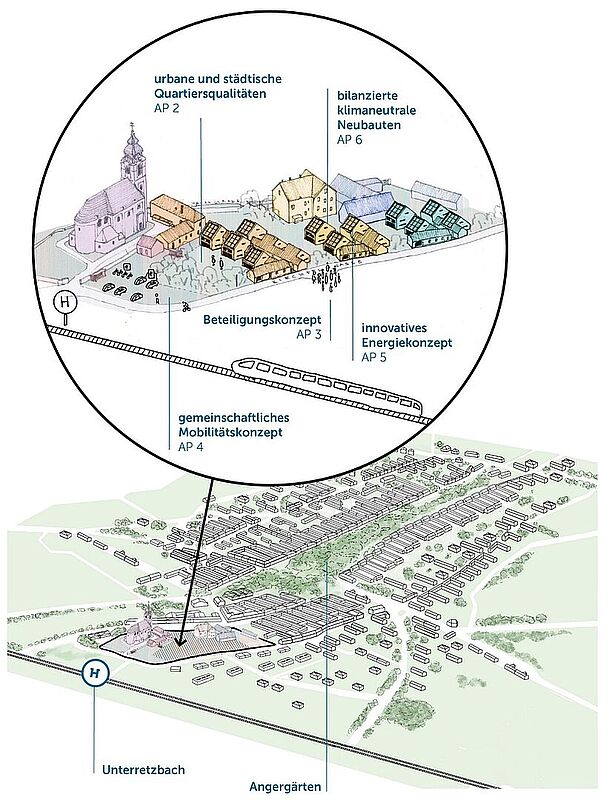
A key focus is on implementing a circular construction approach using regional resources and opportunities for reuse. This materials-based approach is intended to reduce CO2 emissions during construction as much as possible. To minimise soil sealing, the structural concept envisages the use of point or screw foundations instead of large-scale sealing.
The social dimension of the project encompasses the design of diverse housing forms, such as transitional accommodation for young people, (communal) living for older people, intergenerational housing or starter homes for new residents. Methodologically, the planning is carried out through co-creative participatory processes and an ‘anchor space’ serving as a testing ground for stakeholder dialogue. The integrative planning approach is based on a broad participatory process to involve regional stakeholders in dialogue with experts in urban neighbourhood development
In terms of infrastructure, the aim is to establish neighbourhood-based energy communities and a multimodal mobility concept. This involves the integration of electric car-sharing, smart charging infrastructure and the optimisation of footpath and cycle path connections.
The aim of the exploratory study is to draw up a practice-oriented catalogue of criteria and transferable planning documents that will serve as a scalable model for local authorities in similar peripheral locations within conurbations. Economic sustainability is ensured through the implementation of sharing models and the aim to reduce life-cycle costs. This economic approach is inextricably linked to the environmental and social objectives, enabling the project to make a holistic contribution to resource-efficient construction, the promotion of social diversity and active climate protection.