A key component of the project is the integration of climate neutrality, economic viability and social sustainability. In addition to technical solutions, the project also examines financing and operational models, issues of affordability and the active involvement of residents. The LehB: Klimafit Demo 2+1 project builds on the findings of the exploratory project LehB:Klimafit!1,2 and translates the approaches developed there into practical implementation.
Starting situation
The renovation rate for Austria’s existing building stock is currently at its lowest level in ten years and thus significantly below the level required to achieve climate neutrality by 2040. The annual renovation rate of 3 per cent targeted in the Government Programme3 would mean more than doubling the current level4. Of particular relevance here are the non-profit housing associations, which manage around one million flats, most of which have a uniform ownership structure. Many buildings are still heated using fossil fuels5. Comprehensive, climate-resilient refurbishments often fail due to economic, legal or social constraints.
The project builds on the findings of the pilot project ‘LehB: Klimafit!’2, in which transferable concepts for climate-resilient and socially responsible refurbishments have already been developed.
Project goals
The aim of LehB:KlimafitDemo2+1 is to develop and demonstrate climate-resilient and socially responsible refurbishment solutions for social housing, as a contribution towards achieving climate neutrality by 2040, whilst taking technical, economic and social aspects into account. The focus is on how refurbishments can be carried out without jeopardising the affordability of housing. In addition to reducing greenhouse gas emissions, the project also takes into account living comfort, energy efficiency, energy flexibility, the recyclability of building materials and the active involvement of residents. The findings are intended to be transferable to other buildings and to lead to practical recommendations for housing developers, planners and decision-makers.
Implementation
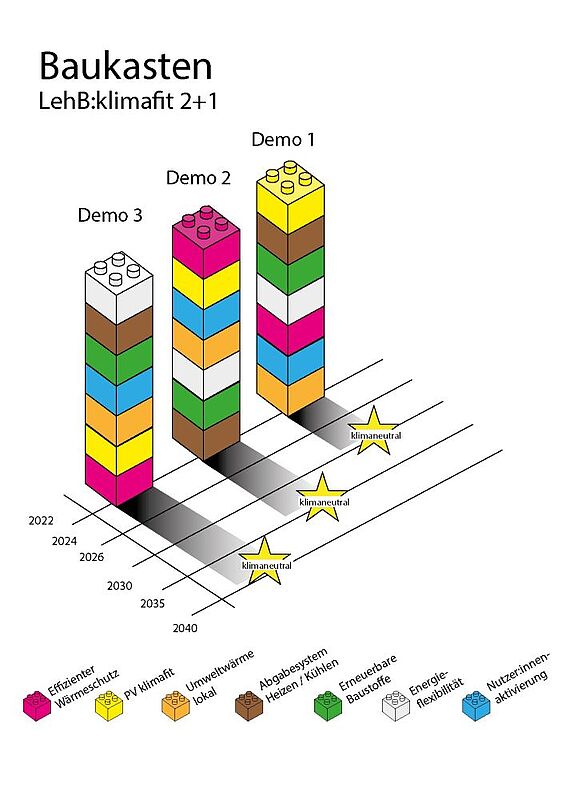
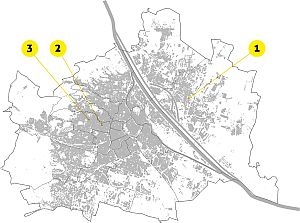
The concepts developed are being trialled on three residential buildings in Vienna with different initial conditions:
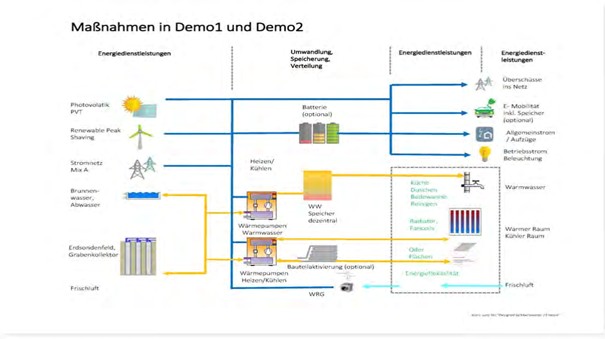
Demo 1 – Climate-fit (= thermal + energy efficiency): For this property, a comprehensive refurbishment within the project timeframe, involving a high level of technical detail, is being investigated. This includes intensive communication support for the tenants, with comprehensive monitoring before, during and after the refurbishment.
Demo 2 – Energy+: A climate-fit phased plan is being developed with a focus on energy-efficient refurbishment (decarbonisation). Awareness-raising initiatives are being trialled as a preliminary step towards securing tenants’ consent for an energy transition. The effectiveness of these measures is assessed through monitoring, and success factors are evaluated.
Demo 3 – Low-Tech: The third building is a property with no reserves, meaning it has minimal or no scope for investment. Cost-neutral, low-tech measures are being developed to reduce individual energy costs, enhance living comfort and cosiness, and maintain basic health standards.
In parallel, energy consumption, living comfort, indoor climate, costs and residents’ acceptance of the measures are being scientifically recorded for all properties. The IBO is contributing its expertise in the fields of building ecology, life-cycle analysis, the recyclability of building materials, and energy, comfort and mould monitoring, and is supporting the development of assessment methods for socially responsible climate neutrality in residential construction.
The findings are intended to be transferable to other buildings, thereby supporting the transformation of the existing building stock towards climate neutrality.
- https://www.ibo.at/forschung/referenzprojekte/data/lehbklimafit
- https://projekte.ffg.at/projekt/4424997
- https://www.parlament.gv.at/dokument/XXVII/AB/2638/imfname_818676.pdf
- https://iibw.at/documents/2020%20IIBW_UBA%20Sanierungsrate.pdf
- https://cms.gbv.at/DE/repos/files/GBV/Intranet%5fdownloads/Intranet%5fdata/Statistik/STAT23%20Publikation%2epdf?exp=63019&fps=084b731e9b049287f9a4ce4f8a7bb90459c024cc